



DispatchMaster
Members
-
Joined
-
Last visited
Everything posted by DispatchMaster
-
I didn't suggest that it did. You stated that the installation of Orion did not meet attendance and ROI targets, and seem to be suggesting that the reason it did not do so is because of the supposed guest sentiment that the ride is "just OK". I'm pointing out that the ride opened during a pandemic, which is a rather monumental factor to consider when trying to analyze attendance and ROI. Therefore, I'm asking how you were able to determine that it was that guest sentiment, rather than a once-in-a-century pandemic, that is primarily to blame for Orion's poor performance.
-
I'll grant the sentiment angle, but I would like to hear more about how the attendance and ROI conclusion was reached. It's not as though public companies go out of their way to share data that demonstrates they made a poor 8-figure investment. In fact, public companies are always inclined to do the exact opposite - perform logical acrobatics to spin poor financial performance as the fault of anything other than their decision making. But more to the point, as Losantiville Mining Co. points out, Orion did not debut in a vacuum! Instead of getting the normal first year bump in attendance - and thus a huge chunk of its expected ROI - Orion debuted during the pandemic, operating a fraction of the expected hours its first year, with limited attendance and capacity. Even in its second year when those restrictions were lessened, a nontrivial number of people simply were not traveling, depressing the park's attendance, and thus further depressing ridership and ROI. There is no way to definitively untangle those effects versus the effect of the supposed guest sentiment that Orion is "just OK".
-
I will provide you with information that is of equal relevance to your claims about Orion - my ranking of 80's sitcoms: Cheers Family Ties The Cosby Show Perfect Strangers ALF
-
I'm asking the question as a means to point out the absurdity of the claims you're making. You stated that the "typical guest sentiment" is that Orion is "just OK". I'm asking how you arrived at this conclusion. Is there survey data somewhere that leads you to this conclusion? You then stated that the park should have done something different in order to "sell tickets". I'm asking how you arrived at the conclusion that Orion did not "sell tickets" or otherwise meet the park's desired goals for the investment. Do you have access to the park's expectations for the ride? Or the performance metrics? Anything at all to substantiate the claim you're making? It's one thing to say that you were personally underwhelmed by the ride, or that you wish they had done something different with the investment. It's another thing entirely to state with certainty that the park isn't hitting its expected attendance marks or that Orion is viewed by guests as underwhelming. Others have pointed it out, but it bears repeating - enthusiasts generally are not great at understanding what it takes to run a successful, well rounded amusement park, because they tend to assume their own preferences are widely shared by the average guest. That is just not true.
-
Why are you assuming the installation of Orion did not sell tickets? More specifically, why are you assuming the performance of Orion has not or will not meet the targeted goals of the investment?
-
Where is this customer feedback?
-
According to what metrics?
-
It comes down to how much a given person values their time. If a FL/FLP pass costs, say, $150, and someone values their time at $50/hr, one need only save 3 hours to "break even", which is relatively easy to do. If you get on 6 rides throughout the day and save an average of 30 minutes per ride, you've come out even. Anything more than that and you come out ahead. Personally, I don't use it to marathon rides or maximize the number of laps I get throughout the day. I use it because I'd rather be enjoying my day at the park without spending the majority of it waiting in line.
-
They've been sending out these surveys every ~year for several years now, right? If so, what's unique about this year's survey that makes you think it's a distraction?
-
It makes more sense to price it high initially and reduce if necessary than it does to do it the other way around. Interestingly, at CP (where the price is also reduced), both the Haunted Attractions Express Pass and Conjuring tickets are sold out online, but that is not the case for KI.
-
It is a manslaughter investigation, which simply means they're investigating an accidental death.
-
Why do you assume this would be the result of outsourcing?
-
No, my position is not that what you are proposing "would not work." I'm saying that there are known built in disadvantages to what you are proposing, and that whatever advantages you're suggesting exist are either nonsensical or not well defined (e.g. "the free market will win the day!", "the human factor!"). And therefore the proposal is, on balance, worse than the modern status quo of fewer, larger centralized food service locations. What you are proposing are not remotely novel concepts. It's not as though parks don't understand the cost-benefit balance with having an outside vendor sell stuff in their parks compared to selling that stuff themselves. And it's not as though parks don't understand the cost-benefit balance of having multiple small food service locations compared to fewer, larger venues. So, the downsides are that product costs (lower volume, more waste), operations/infrastructure costs (rent, utilities, etc.), and labor costs (both number of employees and, now, wages) will increase, while overall efficiency/throughput will decrease. It seems, therefore, that quality would have to improve by a massive margin to make it even a wash, much less an improvement.
-
Except decentralized food service has been done. The only difference you're proposing is that parks have less control over how those food service stands are operated, which isn't a novel idea either. I also think it's telling that you keep pointing to two relatively tiny parks - IB and Knoebels - as "evidence" that this model can be easily and successfully scaled up, and without providing examples of other similarly sized parks that have done so. Just because it is your anecdotal experience that the modern food service setup is unsatisfactory does not mean that the average guest agrees. And even if that were the case, the decentralized food service model offers few, if any, built in advantages that would improve things like quality control, throughput, etc., that would be necessary to improve guest satisfaction.
-
Yes, I recognize that there are benefits to what you're proposing, but that's beside the point, which is that any benefits are outweighed by the challenges. What you're suggesting for regional parks is that a local restaurateur would have to open, efficiently run, and then close a restaurant every single season that is capable of serving thousands of guests every day. That you think this is no big deal suggests an unfamiliarity with what it takes to open and run a successful restaurant. Could it be done? Sure, it's possible. Could it be done while providing equal or superior quality at a similar value proposition compared to what can be achieved currently? No, there are just too many inefficiencies trying to serve food at scale without any of the infrastructural benefits of operating at scale. One of the few things regional parks, at least KI and CP, have actually gotten better at in recent years compared to the 90's/00's is food.
-
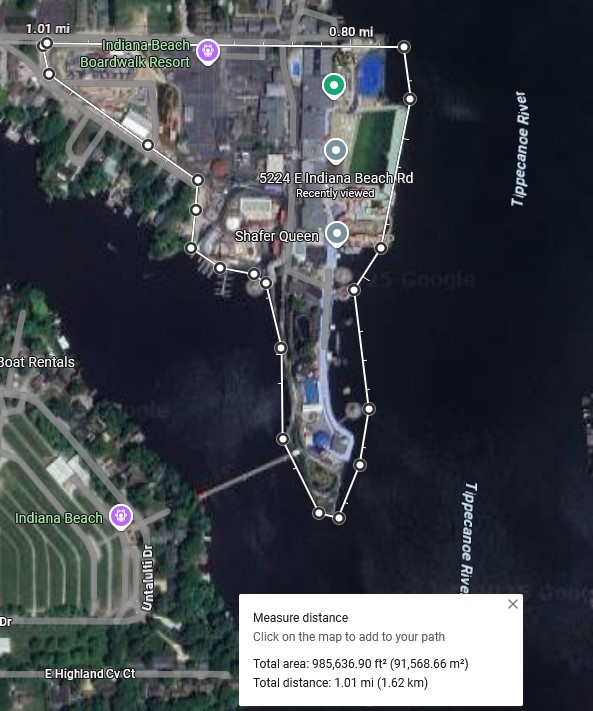
The park in Indiana itself, if we're generous and round up to 96,200 sq ft, is ~2.1 acres. Measuring the park in Sandusky, even ignoring the parking lot which I did not for IB, CP is ~6 times the size of IB. But the land size is merely a proxy for the size/scale of each park. Are suggesting that IB compares to places like KI and CP in terms of the scope of what they offer and, more importantly. their respective annual attendance figures?
-
Because, as mentioned, serving food at scale is a challenge, regardless of the model used. Parks like KI and CP serve thousands of guests per day. That comes with serious logistical challenges, such as supply chain management, consistency, quality control, throughput, infrastructure, etc. How does decentralizing food service address those challenges? That there exceptions that prove the rule further proves the rule. Whether they are chain restaurants run by franchisees or independent local vendors does nothing to mitigate the logistical challenges of serving food at this scale. Could independent vendors produce good results efficiently? Sure, it's possible. But it's not as though being an independent vendor has enough built in advantages to make up for the logistical issues involved. There is a reason parks the size of CP have been moving away from small window serve eateries and toward fewer, larger cafeteria style locations (Grand Pavilion & Farmhouse at CP, Harmony Hall at CW, Plymouth Rock Café at HW, etc.), and it's not because these companies like spending millions of dollars on infrastructure for the heck of it. It's because centralizing these efforts leads to overall better outcomes.
-
Kings Island is more than 30 times the size of Indiana Beach and (I would ignorantly guess) serves at least an order of magnitude more guests annually than IB does. So it's pretty nonsensical to assume what works for IB would work for parks the size of KI or CP. Anyone can cook one decent burger for themselves, but it's a bit different serving burgers for a backyard party with 50 guests. The key to providing good food to millions of guests every season is to do so at scale, which isn't solved by making it someone other food vendor's problem. And it's not as though the bigger parks haven't already tried this. At CP, they have or have had Johnny Rockets, Chick-fil-A, Subway, Fridays, Chickie's & Pete's, Famous Dave's, Melt, Pink's, Panda Express, etc., and in no way did the existence of those outside vendors lead to long term success at serving good food efficiently and consistently.
-
When has this strategy led to long term, sustained success? A fundamental issue with low admissions pricing is that it invites the wrong kind of customer - frugal or price sensitive families, parents looking for cheap summer day care, etc. - who are unlikely to spend frivolously regardless of how things are priced inside the gate. Giving away the gate also squanders a unique advantage these regional parks have, which is that they are down market of Disney-level entertainment options, so if/when economic conditions lead to a softening of demand on the higher end, they can absorb that business, giving up the lower end customer to FECs and the like. Another fundamental problem is that it takes a long time and effort to build gate integrity. Demonstrating to customers that your product is worth the elevated price point you're charging can take years, even generations, and all of that is completely undone in an instant by lowering the gate price. Once the gate integrity is destroyed, declining revenue and per caps, and attendance when the economy softens, make it virtually impossible to correct course before bankruptcy is the only option.
-
Social media is not real life. A quick perusal of park-centric "social media" would have me believe that literally every ride at every park is closed for several hours every day, and when not closed, almost killed their father's, brother's, nephew's, cousin's, former roommate due to a restraint malfunction, etc. It's all meaningless nonsense propelled by algorithms designed to trigger outrage. As pointed out above, the only thing that matters is whether the parks are still pulling in revenue on Saturdays in October. And there has been absolutely zero indication that the parks will have any difficulty doing so. I agree that the messaging strategy regarding now up-charging for certain attractions was poor. But the fact of the matter is that it has never been cheaper, in my lifetime at least, to visit the parks. If anyone is so so price-sensitive that they're going to complain about the value proposition, previous fall attendance trends suggest that there are literally thousands of others who will happily take their place, ready to pay extra for access to haunted houses.
-
Where are we seeing "widespread backlash"? I've seen a few news pieces explaining that the parks will be charging for haunted house access, but nothing more than your typical amusement park announcement coverage. I do agree, however, that giving away the gate has been a disaster, which is frustrating, because it was totally foreseeable. Cheap season passes were a terrible idea from the beginning, and their bizarre "strategy" of doubling and tripling down on it has not been helpful, because as a result they are attracting the "wrong" type of customer, which may be why the Q2 per cap at the legacy CF parks barely keeping pace with inflation.
-
To be fair, if they were comfortable paying for it, they wouldn't be gauging interest in it. If they were comfortable with paying for it, they'd just build it. But they need to gauge interest to determine whether or not there's a financial case to be made. So why haven't they built any? They had opportunities, specifically at CP or CW, but instead chose considerably smaller versions, even at Cedar Point, the so-called favorite child of the chain that gets all the best stuff. Now, this is not to say they absolutely would never build a dive machine that tall. But considering that every added foot to a coaster's height has diminishing returns - guests/riders can't distinguish between 299' and 301', nor can they readily distinguish between 301' and 315' - parks have to ask themselves how much value there is in the marketability of a 301' ride versus a 299' ride. And even if we assume that extra 2' might be justifiable in terms of ROI, going a further 14' isn't necessarily a slam dunk.
-
The taller the coaster, the larger every element needs to be to stay within comfortable G-force range. The larger each element is, the more steel is required. And steel is expensive. Have you ever wondered why there are so few coasters taller than ~300 feet? It's because it gets stupid expensive very fast to build even a narrow gauge (e.g. Orion/Leviathan) coaster at that scale. It may be hard to tell without looking at them side-by-side, but dive coaster track is a lot larger than traditional track. The rails are set wider to accommodate 8- or 10-across trains, so that means more massive ribs, and the spine is wider/thicker as well, since the moment about the track axis is much greater compared to sit-down coasters. And then of course the support columns need to be sized up to support the static weight of the track. All of this adds up to a very difficult ROI case for a dive coaster of that size. One constant in the enthusiast community is how freely folks are willing to spend park operators money, as if it were RCT in sandbox mode. In the real world, where budgets exist, things are more complicated.
-
Correct me if I'm wrong, but a dive coaster as high as the ET would be about 40% taller (!!!) than the two tallest dive coasters yet (Valravn & Yukon Striker). The only place a dive coaster of that height is likely to be built is Saudi Arabia. It's just too expensive.
-
You suggested that the new coaster may be heading to CP because the park's expectations for hotel reservations were not met. I pointed out that it's nonsensical to spend several million dollars to sell a few extra rooms because in addition to it not making sense financially, dynamic pricing allows them to throttle demand in real time, and at no cost to the park. That the park's hotel has local competition or that there's an amusement park there are red herrings. If Cedar Fair felt the resorts were not meeting their target, they would simply dynamically lower prices until demand increased to their target. Conversely, if demand were outstripping supply, they would dynamically increase prices until the two were in balance.