



Leaderboard
-

TOPGUN1993
Members4Points4,789Posts -
The Interpreter
Members4Points62,336Posts -
Gordon Bombay
Members4Points8,218Posts -
Browntggrr
Members3Points8,627Posts

Popular Content
Showing content with the highest reputation on 04/18/2012 in all areas
-
3 points3 points3 pointsAnd the Terpster was hawking cheeseburgers, fish, french fries, fried chicken and roast beef from behind a stainless steel counter in front of a spherical glass bowl full of uncarbonated Orange Crush (often fermented) recirculating through a plastic three tier fountain. Driving a huge, dilapidated '67 Ford LTD to haunted houses (tell me people don't change!), and plotting his escape from the small Kentucky city where he was born and raised. Even then, his career interests were much the same as now....the restaurant industry, marketing, planning, writing, and interpreting. It was a very different world, then, though. A 20 minute state to state direct dialed weekend long distance call was promoted by Bell Telephone as $3 or less. Operators were still common, and many people placed person to person calls (you didnt pay unless the operator reached the person you asked for, you didnt even have to have the phone number) and asked for a fake name. The operator would ask for that person, and, say, your parents would then know you made it back to college safely. If they slipped up and accepted the call, the charge was huge, with a three minute minimum, typically $4 or so. (minimum wage was $1.60). 911 didn't exist. In an emergency, you just dialed the Operator. Most gas was sold at full service gas stations, nearly all of which had lube and light repair service. A full tank often got you a glass or plate or bowl. Fast food included fresh cut fries (although McDonalds was switching to frozen), slaw made in the store, and very little pre-prepared items. Orders were taken on a pad with a pencil, manually added, only the total rung on the register, and orally called out to the kitchen. Cameras to observe employees were big, expensive and rare. Employee theft was far more common. Driving was actually probably far more expensive than now. Yes, gas was 36.9 cents a gallon, but cars broke down frequently, flat tires were very common, tune-ups were required far more often, carburetors required far more maintenance and spark plugs fouled quickly on the leaded gas then used. Premium fuel was called Ethyl, from the company that made most of the lead additive. The Racer was the biggest roller coaster I had ever seen, and I thought I'd never see one larger. Kings Island was brand new, no one knew its future. It was owned by a broadcasting company that many saw as on a par with Disney in many ways. The park was a gleaming showplace, and the entire region was very proud of it. It was a family attraction, with a balance of incredible entertainment produced at a near Broadway level, exquisite carefully prepared food, lush landscaping and oh, yes, rides--some themed but many not. It was a different time, it was a simpler time. And 40 years from now, someone will say the same of now. The circle of life continues. My parents took me to Kings Island because they knew how strongly I was attracted to it and they wanted to enjoy a family experience. Today, thrills connect.3 points2 points2 pointsNever been on a boring ride , love them all, no matter what they are as you can experience somehting new, sure you may not quite exactly like it but its wonderful, mixing it up is the spice of life. !2 points1 pointSo I Binged Kings Island and found this blog. http://www.scaryforkids.com/kings-island/ While it is old it still provided me a great laugh, especially the comments section.1 pointAfter just looking at Kings Island's Timeline located on their website, http://www.visitkingsisland.com/media-center/timeline There is a transition between every year starting with a new ride then the next year a area getting redone, starting with the 2003 season. 2003- Delirium, Scooby Doo & The Haunted Castle, Spongebob Squarepants 3D 2004- The redone and expanded Crocodile Dundee's Boomerang Bay Waterpark opens 2005- Italian Job: Stunt Track 2006- Nickelodeon Universe 2007- Firehawk 2008- Rides recieve new names all throughout the park 2009- Diamondback 2010- Planet Snoopy 2011- WindSeeker & Dinosaurs Alive 2012- Soak City 2013- ????? With this guess, I think Kings Island will be recieving another ride in 2013? Who knows.... Im just guessing. Tell me what you guys think.1 point1 point1 point@KingsIslandPR has posted a picture of the cover for the 2012 park map on twitter. Here is a link to the pic on twitter. http://t.co/GFDGnSVC1 pointhttp://www.visitkingsisland.com/public/park/soakcity/2012/compare.cfm1 pointI think ki will add some sort of water slide or something to Soak City next year and tear down SOB , while CP will add a new coaster,then in 2014 SOB will be replaced by the largest steel invert in the world.1 point1 pointUmmmm, my wife just informed me that if we go to CP this year and its packed we are getting fastlane, so i guess i will tuck my tail between my legs and shut up now! lol1 pointI am amazed at how many people tell me #1 on your list.1 point1 point1 pointLet me play devil's advocate here for a minute. You may be comparing apples and oranges there, and here's why: Those guests in the FL would, without FL, all be in the regular line, making the regular line longer. It might be that the wait time in a given situation is the same as it would be without FL, only that the the line is physically shorter (because guests are split between two lines instead of all being in one line) and thus misleading you as to what the wait time without FL would be. Does that make sense?1 point1 pointNot going to a park because of a "Fast Lane" type perk will certainly limit the parks to enjoy.1 point[Frank Oz voice:] "There is no try. Do. Or do not. Roller coaster riding leads to pleasure; pleasure leads to thrill; thrill leads to funnnnnn!" EDIT: Oh, darn, there's no 'Yoda' emoticon. Look hard enough and you'll find one1 point[Frank Oz voice:] "There is no try. Do. Or do not. Roller coaster riding leads to pleasure; pleasure leads to thrill; thrill leads to funnnnnn!" EDIT: Oh, darn, there's no 'Yoda' emoticon.1 point1 pointSo...with this kind of attitude there never would have been an American Revolution...a protest against the Vietnam War... I choose the road less traveled. P.S. Nothing personal Gordon...you know I like you a lot. Trust me, nothing personal taken! You know I think you're awesome. I think the American Revolution and Vietnam are a little dramatic of a comparison, haha. My point is, systems like this are an industry standard and a tiered experience not uncommon in the entertainment realm. Where I see problems with Fast Lane is how they execute it, I think it really gives off an of "unfair" to guests who aren't buying it. Hence why we saw that article someone posted recently. You can use it an unlimited amount of times and while they claim they cap it, they're certainly waiting quite awhile on busy days to cap it. Other parks in the industry utilize timed systems with an electronic assistant, CF gives you a free for all with wristbands and the regular folks waiting in line can clearly see those guests coming back and going over and over again. I think there's a nice balance that can be found to make such a system work well in the eyes of both premium and regular paying customers, they just need to implement that.1 point1 pointLet's not forget the venerable "Scooby Doo" coaster, whose yellow beams were visible in a few shots of the show as well.1 point1 pointWow, that Flight of Fear picture brings back a lot of memories. It was a very warm and sunny June Monday. I just graduated from Princeton HS and was working in an office in St. Bernard. They didn't want me taking a lot of time off since I was only going to be there for a little more than two months, but they graciously allowed me to take a half day which meant I could leave at 11. I snuck out a little early, stopped back home, picked up my friend Mike in my freshly washed '84 Accord and headed to the park. We got to the park a little before noon and headed back to the ride. I believe the official opening of the ride was supposed to happen at noon. We got to the ride only to discover that there were a few people in front of us. They were holding the line outside of the building, but I remember the line stretching under The Racer (as shown in the picture). We followed the line which then wrapped around to the right, past the swings, past the arcade, past the speed pitch and ended right around the old Flight Commander spot where we found a spot at the end of the line. I believe the line backed up to at least Vortex by the time we started moving after the ride officially opened. There's nothing quite like the energy that flows from the crowd during a big ride opening. I flashed back to the Cincinnati Enquirer article about the new ride, the specs, seeing the track layout for the first time and realizing that we were finally going to turn all of the anticipation into realization. I think that one brief moment is the reason why I love ride openings so much. It's not just the fact that you're going to get to ride but more that your frame of reference is going to shift. Your life, albeit it in a very small way, will be forever changed simply by being in that moment. It's a collection of things that will form an experience you'll remember for years to come. Your senses are heightened. The ride will be there for a long time but the experience of that day is singular. I remember waiting outside in line for an hour and being happy we finally got to the part of the queues in the shade. I remember the anticipation of going down the ramp and seeing the inside of the building for the first time. I remember seeing the mirrors along the wall and mistakenly thinking we were only seeing half of the queue line. I remember the what seemed like hundreds of times we saw the pre-show video while in line. I remember the couple of breakdowns where the line wouldn't move for 20 minutes at a time. I remember finally making in into the spaceship. I remember hearing the launch for the first time and subsequent screams, oohs and aahs. I remember seeing the launch for the first time... Zero to sixty in four seconds sounds impressive on paper, but I doubt that anyone who was there that first day will ever forget what it was like to see that train launch for the first time. Perhaps it was the fact that you could only see the top of the train being propelled into the tunnel only to disappear quickly into the abyss. I remember turning to my friend Mike with what I imagine was an open mouth and him turning to face me with exactly the same look. You then looked around to see the same look on so many other faces. I think that one moment instantly made the wait worthwhile. Five hours in line later we boarded in the second row. It's interesting because I only remember 3 things about the actual first ride: the launch, seeing that first part of the cobra roll out in the distance, and that low to the ground and corkscrew finale being taken at what seemed like a ridiculous speed. And then it was over. "That was fun", we heard the riders in the front row exclaim. Mike and I both nodded our heads in agreement. A great end to what was a cool experience. I probably had more fun at the openings of Son of Beast and Diamondback but the opening of Flight of Fear was definitely more memorable. That ride started what was the best summer of my life up to that point. Each time a major ride is announced at KI I realize that it's more than the ride that I look forward to. Those opening day moments at that ride are forever entwined with the ride itself. It's vivid memories of the park being etched in your mind that serve as reminders for how the park, you and others who shared in those moments with you continue to evolve. There's really nothing quite like those big ride opening days.1 point1 pointAt a certain park chain that numbers its flags, loyalty perks include discounts on season pass renewals, among other things.1 point1 point1 point1) Introduce three of my best friends and my mother to Disneyland Resort this May. 2) Not cry during World of Color, but bait my friends into crying. 3) Take plenty of photos of us, not rides. 4) Not stress out about wait times, closures, or prices, but simply enjoy the short time I have with the people who mean so much to me.1 point
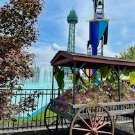
 1 pointI should add, although I'd assume it's a given, that it's the poles that are still there and not the actual banners... it'd be pretty hard to miss those Here's a picture from International Street of one of the poles. It blends in almost perfectly with the surrounding trees: Obviously nothing too special, but still something interesting in my opinion1 point1 pointI've never seen that view of the train before...very interesting. Thanks again, I'm going to hate when these are over!1 point1 pointThank you for posting that. Wish the train had more like 1974.1 pointThis leaderboard is set to New York/GMT-04:00



Background Picker